This title refers to an infamously disputed body of work. First of all I refer to this text I have been reading as a "seminar". More precisely Lacan's Seminar V. However, it was never written as a book. Like all his other seminars, it was delivered orally and then transcribed. The afterlife of these transcripts, is in the hands of archivists, scholars, and Lacanians, who are gathering various documents, oral testimonies, and notes.
It follows from this that it is impossible to cite any definitive Urtexte because Lacan’s seminars have been subject to interpretation and reinterpretation from their transcripts and hearers, let alone dozens of translators.
Third, it must be underscored that these texts remain raw. Though the seminars craved editorial input, it never happened for decades. The transcripts anonymously amongst the Others, who in this case were devoted colleagues and pupils. Not surprisingly the circulation of raw transcripts led to suspicion, legal debates about ownership, and -the very big question- as to whether Lacanian teachings and the psychoanalysis he constantly reconstructed could ever be transmitted in an authoritative, unitary, and smooth fashion.
For the purposes of this brief note, I indicate how, towards the end of this seminar, Lacan comments on the concept of obsession. He believed the root obsession was a persistent rumination as to whether the Subject itself "is" alive or dead. Death is therefore a necessary association (or signifier) for any Lacanian account of obsessiveness.
Freud’s death drive is perplexing. Is it singular, plural, or both? A similar question can be asked of his love or life drives. The answer of course, is both. Whatever Freud meant by drives, their trajectories are not immutable. A drive can trigger and change into its opposite. Drives have circuits indeed, but their timings, trajectories, comings, goings and spheres of operation can be inscrutable….. in other words “unconscious”
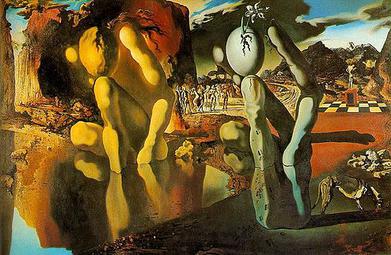
What I find strange about Lacan’s interpretation of Freudian death drives is that he studiously avoids any reference to anything physical or organic. Freud’ death drive by contrast was primarily interpreted by himself as a yearning of the psyche to become organic. As in Dali’s representation of Narcissus, freudian subjects undergo -or desire to undergo- profound metamorphic changes. Of course there was a psychological dimension to such a drive or drives. But death was not solely restricted the associations of signifiers -however unconscious. The image is Dali's Narcissus is repeated several times until it is completely incorporated into a rugged mountainous terrain. Yet the entire tableau is teaming with life including human dancers and animals.
The history of psychoanalysis can be perplexing. Even when Freud was still working and writing, there were many analysts who completely rejected Freud’s death drive. Max Schur, was such a one. Schur (1897-1969) became Freud’s GP in Austria after the founder of psychoanalysis lost confidence with his previous doctors. He accompanied Freud to London. Schur wrote an incredible book about Freud which remains first class but now sadly ignored.To be forthright -it was Schur who looked after Freud’s cancer and assisted him to die. Doctor and patient had a pact. When the old man experienced his pain as unbearable, Schur agreed to inform Anna of her father’s decision and administer a lethal dose.
There were other contemporaries that welcomed the theoretical and practical presence of death drives. Kurt Eissler (1908-1999) was a veteran Austrian analyst who later worked in America. It was Eissler who for many years was responsible for the Freud Archives and collecting interviews from contemporaries- like the family of Little Hans. Finally an abiding inspiration for Lacan was Melanie Klein, for whom death drives were at once psychological, imaginary, symbolic and real processes operating within and without subjects
During the final sections of Seminar Lacan speculates about the word in the beginning. It is an obvious reference to the opening of the fourth gospel, whose author is named John. The biblical text continues:
Καὶ ὁ λόγος σὰρξ ἐγένετο,
καὶ ἐσκήνωσεν ἐν ἡμῖν — καὶ ἐθεασάμεθα τὴν δόξαν αὐτοῦ, δόξαν ὡς μονογενοῦς παρὰ πατρός — πλήρης χάριτος καὶ ἀληθείας.
And the Word was made flesh, and dwelt among us (and we beheld His glory, the glory as of the only Begotten of the Father), full of grace and truth. John 1:14 King James’ Version
But does Lacan’s word ever become flesh? The opposite seems more apposite to me. Rilke tried to make the world invisible with his poetry; similarly Lacan’s signifiers dissolve things fleshly into an infinite succession of associations (or signifiers). It is pertinent to maintain therefore, that the lacanian signifier kills the flesh.
Lacan’s theory of signifiers, as well as Freud’s proposals of death drive, helps one to appreciate the words of Thomas Beckett in T S Eliot’s Murder in the Cathedral. The play dates from 1937, the very year Freud published Analysis Terminable and Interminable
I have smelt
Death in the rose, death in the hollyhock, sweet pea, hyacinth,
primrose and cowslip. I have seen
Trunk and horn, tusk and hoof, in odd places;
I have lain on the floor of the sea and breathed with the breathing of
the sea-anemone, swallowed with ingurgitation of the sponge. I have
lain in the soil and criticised the worm…………………
Corruption in the dish, incense in the latrine, the sewer in the
incense, the smell of sweet soap in the woodpath, a hellish sweet
scent in the woodpath, while the ground heaved. I have seen
Rings of light coiling downwards, leading
To the horror of the ape. Have I not known, not known
What was coming to be? It was here, in the kitchen, in the passage,
In the mews in the barn in the byre in the market-place
In our veins our bowels our skulls as well
As well as in the plottings of potentates
As well as in the consultations of powers.
It can be safely said that these views are congruent with what Miguel de Unamuno called "the tragic sense of life". Traditional Christianity by contrast looks forward to the resurrection of body and the life of the world to come. As Dante explained this is not tragedy, but more of a commedia.
Notes
K Eissler: Death Drive, Ambivalence, and Narcissism, The Psychoanalytic Study of the Child XXVI (1971)
Melanie Klein : On The Sense of Loneliness 1963. Available at https://www.scribd.com/document/377411574/Klein-1963-on-the-Sense-of-Loneliness
Max Schur: Freud: Living and Dying 1972 International Universities Press
Lacan’s Seminar V
French: http://staferla.free.fr/S5/S5 FORMATIONS .pdf
English by Cormac Gallagher http://www.lacaninireland.com/web/wp-content/uploads/2010/06/Book-05-the-formations-of-the-unconscious.pdf?utm_source=newsletter_654&utm_medium=email&utm_campa
Formations of the Unconscious: Book 5: The Seminar of Jacques Lacan: The Seminar of Jacques Lacan, Book V . Edited by Miller, translated by Gregg Polity 2017
See also:
In 1925 Rainer Maria Rilke who wrote to his Polish translator Witold Von Hulewicz
Nature, the things we move among and use, are provisional and perishable, but they are. For as long as we are here, our possession and our friendship, sharers in our trouble and our happiness, just as they were once the confidants of our ancestors. Therefore it is crucial not only that we not corrupt and degrade what constitutes the here and now, but precisely because of this provisionality it shares with us, that these appearances and objects be comprehended by us in a most fervent understanding and transformed. Transformed? Yes, for our task is to stamp this provisional, perishing earth into ourselves so deeply, so painfully and passionately, that its being may rise again, “invisibly,” in us…
we are continually overflowing toward those who preceded us, toward our origin, and toward those who seemingly come after us. ... It is our task to imprint this temporary, perishable earth into ourselves so deeply, so painfully and passionately, that its essence can rise again “invisibly,” inside us. We are the bees of the invisible. We wildly collect the honey of the visible, to store it in the great golden hive of the invisible
From the notes contained in the Duino Elegies, translated by Edward Snow North Point Press, p.70
Maurice Merleau-Ponty Le Visible et l'invisible, suivi de notes de travail Gallimard 1964
Sigmund Freud : Analysis Terminable and Interminable
https://www.projekt-gutenberg.org/freud/endlich/endlich.html
Miguel de Unanmono The Tragic Sense of life English Text 1921 https://www.gutenberg.org/files/14636/14636-h/14636-h.htm


No comments:
Post a Comment